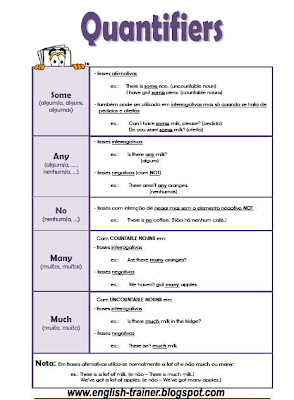
The words that describe the amount of something are called Quantifiers. These are the amount of words that precedes and modify the nouns. How to choose correct quantifier mostly depends on noun, either Count noun or Non-count Noun. The quality of English writing and speech depend on the choice of quantifier and in case of wrong quantifier quality may be detrimental. Let us take a brief look on both count and Non-count Nouns.
Count Nouns
Count noun has simply the same properties as noun that includes name, place, things and unit of measurements i.e. a book, a litter, a mile, an elephant, a house. Count noun can be singular or plural i.e. boy or boys.
In singular form of Count nouns use either "a" or "an" called indefinite articles. The count noun can be made as plural i.e. miles, liters, books, aeroplanes, elephants, managers. You can not use indefinite articles with plural nouns for example, “a managers”, “a elephants” etc.
You can as many compatible quantifiers with count nouns. The examples of compatible count nouns are as under:
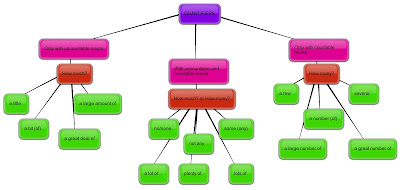
A few, few, these, those, many, none of, a couple of, several, a number of,
A number of houses, many officers, a few books, a couple of litres, and so on.
Now read the non-count or uncountable noun details.
Non-Count Nouns
These are also called uncountable nouns. You cannot make plural of non-count nouns by adding an “s” as it is not in a plural form. However, they frequently take in the idea of including a plural quantity of something. These nouns contain essences, such as rice, iron, water, gold, plastic, glass, iron, ice etc. It is also used in abstract ideas, such as equality, freedom, safety, health, progress. It also contains verbal nouns – insurance, brainstorming, information, dancing, shopping, advice, training, shopping, information and restructuring. There are many other non-count nouns: money, research, traffic, work, employment, cash, software, weather, and so on.
“a” or “a” can never be use before non-count words.
There are different quantifiers are compatible with non-count nouns, some are following:
A bit of, a little, great deal of, no, a good deal of, some, much not, a bit of freedom, much research , some advice, not much money and so on.
There are other quantifiers compatible with count and non-count nouns. Some are following:
All of the, plenty of, most of the, some, a lack of, a lot of, enough, lots of, enough money , lots of work, some houses, lot of miles, some traffic, enough books, all of the information.
You have read this article Quantifiers
with the title
. You can bookmark this page URL https://apostolosmakrides.blogspot.com/2011/10/count-and-non-count-nouns-quantifiers.html. Thanks!